
Most landscaping failures come from choosing the cheapest quote over the longest-lasting installation. Cutting corners on base prep, drainage, and materials causes patios and retaining walls to crack, settle, or lean within a few years, which is why the lifetime cost of a project matters more than its up-front price.
A common mistake when hiring any contractor is putting too much weight on the up-front price. Costs matter, of course. Let the lowest quote drive the decision and you often end up paying to fix the cheapest patio or retaining wall within a few years.
The Number That Matters Is the Lifetime Cost
Think about what your patio or retaining wall will cost you across all the years you’ll use it, not the price on install day alone. A paver patio or segmental block wall installed correctly can hold up for decades in Michigan’s freeze-thaw climate. The same project done cheaply might crack and settle well before its tenth birthday.
Picture two patio quotes for the same backyard. One is a few thousand dollars cheaper because it skips base prep and uses a thinner slab. Five winters of freeze and thaw later, that patio has widening hairline cracks , and a corner has settled enough to collect water after every storm. The other patio, set on a properly compacted aggregate base with the right edge restraint, still looks the way it did on install day.
The Most Common Landscaping Failures We See
Most of the failures we get called to fix look the same from job to job. They come from skipping the parts of the work you can’t directly see. A few we come across again and again:
- Landscape timbers used where the site needs segmental block or natural stone. Timbers rot and bow, and a wall holding back the weight of a slope gives out faster than most people expect.
- Concrete patios poured on a thin or poorly compacted base. Michigan’s freeze-thaw cycles lift and crack the slab, and by year eight or nine it’s buckling and holding water.
- Downspouts and drains that were never tied in correctly, so runoff collects against the house and foundation.
- Retaining walls taller than a few feet with no geogrid reinforcement or drainage stone behind them. Water builds pressure and the wall leans.
- Grading that pitches water toward the house when it should carry it away.
Good Landscape Design Is Preventative
Good landscape design accounts for soil, water, and load before anyone breaks ground. It starts with reading the site: how the yard slopes, where water travels during a heavy rain, what the soil is like a
foot down, and how much weight a wall will hold back.
Those answers decide the whole project. They tell you how deep the base needs to be, whether a wall needs reinforcement, which materials will last in that spot, and where drainage has to go. Get those right, and the patio or wall still holds up twenty years later.
Two contractors can promise the same finished patio, but the one who worked out the base depth and drainage during design is selling you something different from the one who priced a slab and a crew.
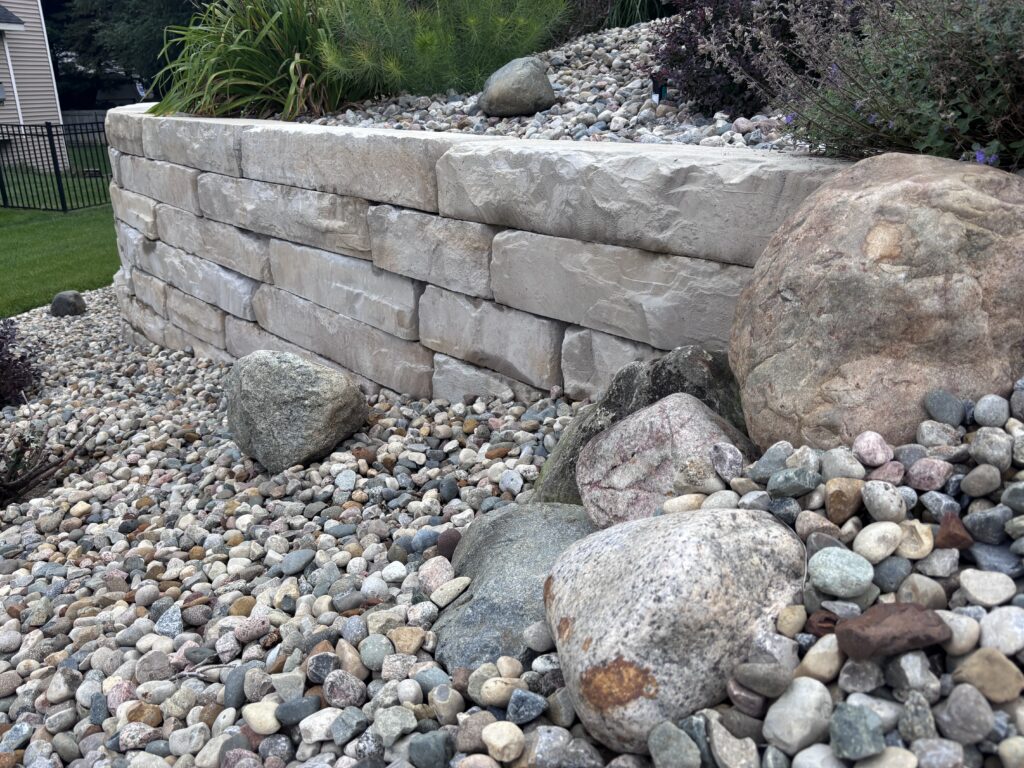
Why Cheap Landscape Design Gets Expensive
Cutting corners saves money in one place and spends it in three others. Here’s how the math tends to play out.
The repair almost always costs more than doing it right would have. Tearing out a failed retaining wall means paying twice for the same wall, once for the initial installation, and again for its replacement. A cracked patio often can’t be patched, so the fix is a full replacement.
Then there’s the damage a failure causes around it. Erosion from a bad drain undermines nearby plantings and hardscape. A leaning wall can take a walkway or steps down with it. Water pooling on a patio works its way into the joints and speeds the next round of cracking. One weak point rarely stays contained.
Hire a Landscaper Who Does It Right the First Time
Whether a project lasts or fails comes down to who installs it and how straight they are with you before the work starts. As you compare quotes and designs, here’s what to ask about and look for:
- Ask about the base and the drainage, not only the surface. A good contractor will explain how they prep and compact the base and where the water goes before you have to ask.
- Get the warranty in writing on the costliest parts. On a patio, retaining wall, or drainage system, find out what’s covered, and for how long.
- Look for a track record. Photos of completed projects, references, and reviews from homeowners near you all tell you what to expect.
- Expect straight answers about trade-offs. The right contractor will tell you when a cheaper material won’t hold up and why, even when it costs them the shortcut.
- Watch how they handle your questions. Someone who takes the time to walk you through materials and processes will take the same care on the install.
Quality the First Time, from Design to Install
At Serenity Outdoors Jon designs every project personally, and the crew installs it to match the plan, which is why our patios, walls, and outdoor spaces are made to hold up for decades across southwest Michigan.
Bring us your questions about materials, drainage, and what your space could become. We’ll give you a straight answer and a plan made to last!